Random, Disjointed, and Self-Righteous Thoughts on TV, Music, Movies, Comics, Musicals, and More
Thursday, October 19, 2006

Wednesday, October 18, 2006

At this point in the "Music Morsels" series, I should be doing a review of an album from my collection starting with the letter 'z.' However, the only album in my collection starting with the letter 'z' is Zooropa, which I already wrote at length about in my "U2 Canon" series. So, I'm starting all over again - but instead of albums, this time, I'll be taking a longer looking at favorite songs. For the first entry of this second volume of the wildly acclaimed (giggles) Music Morsels series, I've chosen Elvis Costello's "All This Useless Beauty."
The timing here is ironic in that I just posted a short story I wrote a while back that was inspired by this song. "All This Useless Beauty" is the title song off of Costello's mid-90s All This Useless Beauty album, and it's one of my favorite Costello songs. This slow, delicate ballad is an early version of Costello in his, for lack of a better word, "standards" mode (a mode that reached its natural conclusion on his album of "new standards," North).
The song starts with a simple piano intro of spare, foundational chords under a pretty descending melody leading directly into the first verse. The addition of other instruments is subtle, with some bell-like synthesized chords coming in shortly after Costello starts singing, and the drums and bass waiting until halfway through that first verse to make an appearance. And it's not until just before Costello sings the refrain (What shall we do/what shall we do/with all this useless beauty?") that for the first time we hear a guitar.
Costello's lyric is chock-full of great lines, and does a fine job of evoking a kind of hazy, limpid fairy-tale feel at the same time as some very modern-feeling lyrics ground the song in the present: "It's at times such as this/She'd be tempted to spit/If she wasn't so ladylike/She imagines how she might have looked/Back when legends and history collide/So she looks to her prince/Finding since he's so charmingly slumped at her side/Those days are recalled on the gallery wall/And she's waiting for passion and humor to strike." It's that intertwined feel of fairy-tale and modern ennui that inspired the spare plot and structure of my story. And that refrain mentioned above has a wonderful wistful, defeated quality, both in the lyric and in the descending melody that ends in a question - the juxtaposition of the downward melody and the fact that we expect to hear a question go up in pitch is very effective.
For the second verse, the instrumentation is fuller and the arrangement has more going on, and Costello introduces a bit of a louder dynamic into his vocals, which, it should be mentioned, are very strong here--powerful and controlled. After we hear the refrain again we get into the bridge, which features the first full-on electric guitar chords, as well as some very subtle, airy background vocals.
The final verse reverts to the spare feel of the first, with the simple piano arrangement dominating. This slow down is an effective lead-in to the final rendition of the refrain, which is as powerful and dynamically strong as anything in the whole song, and which leads to a very strong ending of demonstrative piano chords that fade out to a few odd, soft, bell-like shimmering tones.
"All This Useless Beauty" is one of those songs that I expect to be covered more in the future - it's got that classic, timeless, solidly constructed feel that so many classic songs have.
Until Whenever
Monday, October 16, 2006
This is a story I wrote several years back that I always had a special fondness for.
All This Useless Beauty
"What shall we do, what shall we do, with all this useless beauty?" – Elvis Costello
Grace stared at the dress. It was black, a clean black unshaded by blues or violets, almost an homage to a classic black dress out of a black and white film noir classic from the forties. It lay on the white comforter of their queen-size bed like a black hole. A small exaggeration only; perhaps light was managing to escape its pull, but her attention was unable to evade its grasp. The hem of the dress, she could tell just from looking at it, would barely descend to the level of mid-thigh; sitting in it would be next to impossible. She could already see how it would cling to her shoulders with a greedy firmness, gripping her flesh with squared black straps the width of a piece of Juicy Fruit gum, straps that connected to a perilously low neckline. Hesitantly, as if it were infected, she picked up the dress and held it to her body, observing in the mirror. Just as she had predicted, the neckline would reveal a more-than ample swath of her not inconsiderable bosom. Sighing, she dropped the dress to the bed, sat down beside it and tried to keep from crying.
At twenty-eight, Grace was still a young woman. And, while perhaps not down to her fighting weight, she hadn’t gained that much during the six years of her marriage. She had a round face, reminiscent not of an apple, but a pumpkin. Her blonde, still-full hair hung down to her soft white shoulders, shoulders that mirrored the face with their roundness. While she didn’t know it (and, if she were being honest with herself, she would have thought herself over the edge), Grace, at twenty-eight at least, hovered pretty much exactly on that thin line that separates the mildly attractive from the extremely attractive. In other words, as she walked down the street on a summer day in a tank top and shorts, she turned most of the men’s heads she passed, but not all of them. Her figure was similarly precariously posed. She was round in the right places, and generous in her curves, and stopped just short of what, to the peculiar standards held by the majority of men in the twenty-first century, would be considered heavy. And yet, even taking into consideration her slight (and only slight, mind you) overestimation of her own visual appeal, Grace did not enjoy showing herself off.
Dimly, through the closed door, she could hear the shower running. She and Jim didn’t fight often; they’d done it enough, however, for her to know that he’d be in there for a considerable length of time. Especially after this one; it had been quite a row. She had been laying out her clothes for the Christmas party when he came home. She was quite impressed with the dress she had found only hours before; it was a floor length red number, elegant, refined and demure. In her mind’s eye it was of a similar class to the dresses the stars wore, the ones that made the best-dressed lists anyway, to the Oscars each year – a throwback to the days of glamour and class. It had called out to her on the rack, just at that moment when she had been about to admit defeat, and she had gladly answered. When he entered their bedroom, she had just emerged from the shower, a pink towel lazily encasing her in a three-foot tall tube. Having been sure to leave enough time for Jim to get ready after he arrived home, his early arrival surprised her. As she emerged, Jim was standing in the bedroom, still in his white shirt and blue tie. In his hands was a garment bag, and she had been simultaneously charmed and repulsed by the strange grin he had on his face as he, with an awkward wink, motioned to her with it. In the bag, of course, was the little black dress; he had, so it would seem, taken it upon himself to pick out her clothes for the Christmas party that night. The fight had started before he had even opened the bag; he couldn’t understand why she wouldn’t even look at it, especially since all she was able to find was, as he so dismissingly put it, “that old maid’s thing sitting on the bed.” And with that, they were off. She had been upset enough before he took the dress out of the bag, even as she asked him, and asked him, and asked him, not to. But once she got a look at what he expected, no, what he was in fact demanding that, she wear, all hell broke loose. And so it was that she sat on the bed, listening to the shower and contemplating the, to be frank, whore’s dress she was supposed to impress his associates with that night.
It wasn’t always like this, Grace knew. Once upon a time, a time long ago, a time when legends and history had collided, she had been a princess. She had been wed to a handsome, noble and wonderful prince. And, during the first year of their marriage, in order to celebrate their union, a ball had been scheduled. And her prince had been determined that she be, not the most beautiful maiden at the ball, for, as he assured her, that would undoubtedly be the case, but also the most beautifully attired.
And so it was that, months before the ball, her prince made it his duty to seek out the most talented dressmaker in all the kingdom. This was no easy task because, at the time of his father’s reign, the kingdom comprised a vast and far-reaching territory, overrun with craggy mountains, vast lakes and even, in the far Northwest corner, an arid and scorching desert. Yet, undaunted, he had struck out, searching the land for the most talented dressmaker he could find. She had kept track of his progress through the messages he had sent via hawk; each morning bore a new message from the prince, and each message a new disappointment. As for the disappointments, she couldn’t quite understand what her love was disappointed with, as the sketches he passed along as proof of the various dressmakers’ incompetence seemed stunning to her. And yet, she was content, for she knew that when he finally found an artist he was satisfied with it would be an artist to rival all artists, and she nearly shuddered in anticipation of the gown that she would wear to the ball.
Sure as the sun rises in the sky, the time finally came when her prince returned to the castle, a wizened old man in tow. The wizened old man, upon meeting her, had gasped and proclaimed it an honor to be given the privilege of designing a gown for one as beautiful as she. The days passed, and she was nearly overcome with curiosity at what the man would produce. She was allowed no hints, no peeks; now that the artist had been chosen, she was presented with no sketches of the man’s work, future or present. The night of the ball eventually, as it had to, came and it was with a wonderfully tingling and heightened sense of nervous anticipation that she awaited the masterpiece in her dressing room.
With a knock on the door, her prince came in, bearing in his arms the most delicate piece of gossamer ever spun by mortal hands; the merest sight of it took her breath away and, when it returned, it brought with it tears of joy. What the gown was made of she had no idea; if she didn’t know any better she would have been convinced that the golden clouds of heaven itself had provided the raw material the dress had been spun from. When she slid into it, slid into a fit so perfect that the gown might as well have been peeled directly from her body, the feel of the fabric on her soft and scented skin gave her pause, and led her to think that perhaps those golden, heavenly clouds had been involved after all.
After it was in place, she turned and looked at the mirror. This time, her breath was not so quick to return. She fairly glowed in the beauty of the gown; it truly was a part of her, and she instinctively knew that it would have nowhere near the same radiance and transcendent quality on another. Tears still in her eyes, she turned and kissed her prince, and thanked him for such a wondrous gift.
Still on the bed, Grace shook herself from memories of memories past and contemplated the twin dresses, the elegant red and the revealing black. She thought of the people who would be at the party, her husband’s boss and coworkers, strangers from other departments and spouses and girlfriends and boyfriends, dates and companions as lost as she would be. And she thought of the stares, the looks, lascivious, offended and intrigued, she would garner, with her smooth but not whippet-thin thighs pushing and slightly straining against the thin tight mesh of the fabric and her cleavage all but pouring out of the bodice, tightly pressed and taut, the nipples hanging on to the dark edge of that neckline for dear life. She thought of Jim, his two-beers-a-night potbelly tucked cleanly away by the double-breasted jacket of his tuxedo, telling her that she must wear the dress he had bought, that he didn’t want her hiding her body behind that “red thing.” And she thought of the golden gown that she had worn in antiquity, the barest molecule of a memory of the way it had felt on her skin floating through her consciousness.
The shower stopped, and she looked at the clock. Slowly, Grace reached out , picked up the red dress and started to put it on.
Until Whenever

I finally (finally) got Audra McDonald's new CD, Build a Bridge.
1. "God Give Me Strength" - This is one of the most gorgeous songs to be written in the last decade, just drenched in beautiful sorrow and pathos, and is probably the one song I was most curious to hear McDonald sing. The arrangement is slower and sparser than Costello and Bacharach's original, without that trademark Bacharach horn, and I have to admit to missing it a little. And yet I like that McDonald doesn't just replicate the original, that she does something new with the song. The slow, opening, with only piano for accompaniment, serves as an effective mood-setter, but I'm happy to report that McDonald unleashes some strong belting for the song's dramatic ending.
2. "My Stupid Mouth" - I actually don't know most of the songs on this album, this one included. The first notes McDonald sings are almost shocking (and dismaying), in that she's affecting that soft, almost-speaking sound so many contemporary singers employ. And yet as she progresses, she sings with a pure and gorgeous tone - and yet, remarkably, without ever losing that more casual sound, a sound wholly appropriate to this kind of music. How she does it I really can't say - it's a bit of technical prowess I can't hope to understand - but she nails it beautifully. Which is all the more amazing for how many operatically trained singers have tried to do the same and failed. I mean, most operatically trained singers who try musical theater can't get the idiom right, never mind pop music. The only other opera singer I've heard who was able to sing melodic pop songs this way, with purity of tone and yet the same kind of conversational phrasing the songs demand, is Anne Sofie Van Oter, on her For the Stars album of pop covers.
3. "Build a Bridge" - This Guettel song, which appeared in his Saturn Returns song-cycle but didn't make it onto the Myths and Hymns cast album, is quintessential Guettel - there are a few chord changes here that echo other material from Myths and Hymns. I like the song and the performance, but it does feel a little out of place. And as much as I love this album, I do wonder if McDonald wouldn't have been better served by cutting the theater music entirely and going for an album of only pop songs. I imagine part of the intent was to demonstrate how well a good contemporary pop song can sit beside a good contemporary theater song, and by limiting herself, with one exception, to songs by theater composers that aren't actually part of narrative musicals, I can see how she was aiming to stay away from that overt theatricality even more clearly. But, her admirable efforts notwithstanding, the differences between the two genres sometimes make the album feel a little schizophrenic.
4. "Cradle and All" - I had never heard this Jessica Molaskey/Ricky Ian Gordon song before and don't know the context at all, but it's a real find, with a very modern pop/theater hybrid sound. And the topic - a grown woman singing a lullaby to parents she must now care for - is little-trod ground. A sad, pretty song.
5. "I Wanna Get Married" - If the album has a "dud," this is it. Sickly-sweet ironic song about the overwhelming desire to get married, with lots of winking jabs at 50s-style traditional marriage roles. ("I wanna get married/I need to cook meals/I wanna pack cute little lunches/For my Brady bunches/And read Danielle Steele.") I get the intent, but it comes across more as arrogant and smug than anything else.
6. "Dividing Day" - This gorgeous, deeply melancholic song from the musical A Light in the Piazza gets a deeply felt reading, but the art-song-by-way-of-modern-jazz arrangement drains some of the rhythmic effects from the original, taking away some of the song's musical DNA and rendering it just a tad more generically pretty than it really is.
7. "My Heart" - This simple, but remarkably effective version of the Neil Young song is a highlight of the disc. Stately, measured, and assured - I was frankly astonished at how well a Young song transferred to this type of singing.
8. "Damned Ladies" - A flamenco-sounding piece from Rufus Wainwright. I like Wainwright, but there's nothing special here to my ears - I wish she had done "Poses."
9. "Wonderful You" - I've never heard of Kelly Williams, but this sprightly, infectious song, with its acoustic guitar-driven arrangement, is a welcome breath of fresh air on a disc that can sometimes come off as maybe a bit too moody.
10. "To a Child" - One of two Laurie Nyro covers. I'd never heard of Nyro, but this and the following song may spur me to exploring her stuff. This slow, chiming, quietly dramatic song reminds me of Burt Bacharach's pop-theatrical style, with its shifting meters and surprising chord changes.
11. "Bein' Green" - McDonald truly astonishes me on this track. For a singer with the chops she has, with the powerful, pure, strong voice she has, to sublimate that sound so well - without coming across as coy or affected - is just remarkably impressive. I mean, this is a song that was expressly written for a "non-singer" - for, in fact, a green felt Muppet. And she sings it with just the perfect balance between quiet, almost spoken understatement and true, beautiful tones. A little mini master class in and of itself. Oh - and the quiet, solo-acoustic-guitar arrangement was the exact right choice.
12. Tom Cat Goodbye" - The other Nyro track is a bit of a romp, a fast, almost (but not quite) rocking, song about a woman exacting revenge on a cheating lover. In this song, I can easily hear the blend of theatricality and pop that McDonald was drawn to, with its fast beat, pushing drums, and mix of fast and slow sections.
13. "I Think It's Going to Rain Today" - The other songwriter this disc has me itching to explore is Randy Newman. It took me a while, but I finally realized where I had heard this sad, beautiful song before - it was used in the season finale of Gilmore Girls a few seasons back, when Lorelai and Rory split. McDonald's rendition is impeccable, understated, reflective, and sung to a very effective piano-and-strings arrangement.
Until Whenever
Friday, October 13, 2006
1. "King for a Day" - XTC - Upsy Daisy Assortment
What is the line between homage and plagiarism? This (quite good) XTC song has very similar chord changes, lyrics, and melody and theme as Tears for Fears' "Everybody Wants to Rule the World." Discuss.
2. "Let's Call the Whole Thing Off" - Harry Connick, Jr. - When Harry Met Sally (Soundtrack)
Connick's spare arrangements work, but I was disappointed that the soundtrack didn't have the original renditions found in the film.
3. "Brothers in Arms" - Dire Straits - Brothers in Arms
The use of solo guitar as a kind of call-and-response with the hushed lyrics is simply inspired. It's really duet between voice and guitar.
4. "Original of the Species" - U2 - How to Dismantle an Atomic Bomb
I sing this to my little girls on occasion.
5. "I Don't Believe You (She Acts Like We Never Met) - Bob Dylan - The Bootleg Series, Volume 6: Live 1964 - Concert at Philharmnic Hall
One of those early Dylan songs I just can't get into.
6. "Battle of the Heroes" - John Williams - Star Wars: Episode III--Revenge of the Sith (Score)
Just a stellar piece of scoring, and a worthy final theme for the Star Wars trilogy.
7. "Platform Nine and Three-Quarters and the Journey to Hogwarts" - John Williams - Harry Potter and the Sorcerer's Stone (Score)
The main theme Williams wrote for the Harry Potter films is pretty much perfect, but some of the incidental music feels very much phoned in - this is a case in point.
8. "On the Road Again" - Bob Dylan - Bringing It All Back Home
Dig that Spy Hunter-like beat.
9. "Solfeggio (1964)" - Arvo Part - De Profundis
Hushed and glacially slow. Oh, and uncommonly beautiful.
10. "Little League" - Andrew Lippa - John and Jen
A kid hates baseball because his mother is overbearing. I still can't figure out why I'm so indifferent to this when Lippa's Wild Party is so good.
Until Whenever
The fourth episode of Studio 60 was much better than the first two I saw, and I am newly encouraged that Sorkin can focus enough on the backstage drama to make the sketches themselves non-essential. I thought the very brief glance we got of the "Juliette Lewis hosting Meet the Press" sketch struck a perfect balance between giving us something but not too much - by allowing us to believe that the sketch could be quite funny without having to see it.
But the real point of this post is to wonder aloud at what feels to me to be a very, very odd choice. Why is 60 using the same font as The West Wing for its titles and on-screen time and location guides? The West Wing font always seemed to me to be a perfect choice for a political show about changing the world - somber, idealistic, and simple. How on earth does that same font fit in this world of drugs and comedy? It doesn't. And I can't for the life of me imagine why they chose to just use the same damn font. Anyone have a theory?
Until Whenever
Thursday, October 12, 2006
Wednesday, October 11, 2006
Random Top Ten!
Top Ten Candy Bars
10. Twix - It's a cookie and a candy bar!
9. Snickers - Noting fancy, but it gets the job done.
8. Dove Bar (Dark) - Dark chocolate rules over all chocolates.
7. Kit Kat - Kind of like a Twix, but better somehow.
6. Mounds - Coconut and chocolate get along well.
5. Hershey's Dark - Dark, like I said.
4. York Peppermint Patty - Mint and chocolate could break up the marriage of coconut and chocolate.
3. 100 Grand - A mix of all sorts of good stuff.
2. Charleston Chew - Remarkable frozen.
1. Baby Ruth - I like these with ice and Coke, all mixed together in my mouth.
Until Whenever
Monday, October 09, 2006
Gordon, over at Blog THIS Pal!, has set up a mixed CD exchange, with the topic "Law and Order." I reviewed Lefty's disc here. Today it's time to take a look at the melange of musical morsels I put together, the mix entitled "Peril under the Proscenium."
As the title suggests, I decided to go with an all-theater music mix. My thinking was pretty simple - I very rarely get the chance to force people to listen to musical theater, so given that opportunity it would be well-nigh irresponsible to pass it up. So I delved into the recesses of my collection to come up with the following highly theatrical mix:
1 & 2: "Prelude" and "Prologue" - Jake Heggie - Dead Man Walking
I wanted to do something theatrical with the mix - not crafting a story that would run through the mix, but in framing it with some kind of overall arc. I liked the symmetry of starting and ending with songs that effectively told a mini-story, and on top of that of having those specific songs be not mildly, but strongly theatrical - big, dramatic, powerful. I had some trouble finding an appropriate pair, but once I expanded my search into the opera side of my collection, the perfect pair just jumped out at me. The "Prelude" and "Prologue" of Jake Heggie's wonderful, earthy opera Dead Man Walking start the piece out with an appropriately dark, sorrowful mood. The sinuous, twisting, sad melody of the opening orchestral piece serves as a very effective opening to a mix that will be filled with murder, cannibalism, lynchings, gang fights, assassinations, and arrests. That orchestral piece leads directly into a bit of scene-setting, with a young couple enjoying an amorous date in their car in the woods. We hear a country ditty on the radio before the dial is turned, with the couple settling on a romantic "Kenny G"-like smooth jazz piece. (Both pieces were written by Heggie.) Shortly after, we hear the couple attacked, with big, bold blasts from the orchestra underscoring the couple's brutal murder. I love the way a disc intended to look at criminals starts out with so fundamental and horrific a crime, and with music that presents it so directly and viscerally.
3. "Kesa" - Michael John LaChiusa (sung by Idina Menzel) - See What I Wanna See
I love the transition here - the terrified screams of the girl and the violent, panicked outbursts of her killer fading away to the sounds of a sinister-sounding, sexual vamp. In this song we hear a woman contemplate her last moments with her lover, as she welcomes into her bed for one last bout of passion before murdering him. The music is sly but dramatic and Menzel does a fine job of injecting a bit of erotic, sexy urgency into the explicit lyrics.
4. "Mike's Song about Arresting a Particular Individual" - John Adams - I Was Looking at the Ceiling and Then I Saw the Sky
The dissonant, minimalist, yet almost poppy sound of this energetic track stands as a nice, modern counterpoint to the more stately sounds of the previous. Here we have a police officer arresting a young black man for shoplifting a bottle of beer, and in the officer's cocky, angry singing we hear a whole palette of racial disharmony. I also like how this track gives us the perspective of the "Order" side of the "Law and Order" equation on a disc dominated by criminals and their stories.
5, 6, 7, & 8 - "The Trial: People of Atlanta," "Twenty Miles from Marietta," "Frankie's Testimony," and "The Factory Girls/Come up to My Office" - Jason Robert Brown - Parade
I wanted to include a good scene or two in the mix, as opposed to just stand-alone songs, and this mini-section from the musical Parade (which tells the story of a Jew in Atlanta who was falsely accused of brutally murdering a little girl, an employee at his pencil factory) was the perfect fit. We go from the announcement of the trial, to the prosecutor's opening remarks, to the testimonies of the victim's friend and fellow young employees. I love the mix of modern and Southern that Brown gets in his music in this score, and the centerpiece of this section--the haunting testimony of the young girls" is just a gorgeous piece of music.
9 - "The Ballad of Booth" - Stephen Sondheim, sung by Victor Garber and Patrick Cassidy - Assassins
The segue her is nice in that it's another bit of Southern-feeling material and in that it's another lengthy scene. This song-scene, with the Balladeer (a narrator figure) being beseeched to tell John Wilkes's Booth story is a masterful piece of writing. The aria-like centerpiece of the scene, in which Booth passionately defends his actions, is chilling stuff, with beautiful, tender music supporting vile statements. I also like the overt theatricality here, with the gunshots, the interjection of a little scenelet between a fleeing Booth and his partner in crime, and the device of having Booth interact directly with the narrator.
10. "The Vampires" - Paul Simon - The Capeman
Simon's huge flop, which I didn't see in its brief life on stage, has a lot to recommend it, musically. This song has a great Puerto Rican-flavored piano underscore and some nicely sharp and harsh lyrics from the street gang singers.
11. "Mack the Knife" - Louis Armstrong
I wanted to break the piece up with some less-overtly dramatic music, and a swinging rendition of Mack the Knife supplied by Satchmo himself seemed just the ticket.
12. "Strange Fruit" - Nina Simone
I wanted to maintain that distance from the overtly theatrical that Satchmo gives us, but quickly wanted to dispel any lightness his swinging might have provided. Enter Nina Simone's stark, harsh, and unrepentant reading of the Billie Holliday classic "Strange Fruit." Over plaintive and declamatory piano chords, Simone sings the familiar tale of coming across a swollen, lynched body. I love her intense, almost unpleasant reading of this dark song.
13 & 14 "Epiphany" and "A Little Priest" - Stephen Sondheim, sung by Len Cariou and Angela Lansbury - Sweeney Todd
The sorbet-like jazz pause is over and we are back into scene territory. Here we have the searing mental breakdown of a song in which Sweeney Todd decides to murder wantonly, followed by a comic but dark ode to cannibalism, with Sweeney and his landlady deciding to serve his victims as meat pies. It's one of musical theater's great scenes, with "Epiphany," in particular" being just a tremendous piece of writing.
15. "Over the Wall" - John Kander and Fred Ebb - The Kiss of the Spider Woman
After the meaty scene that preceded, this short bit from Kander and Ebb's prison-set drama, about a revolutionary and the drag queen he falls into a complex relationship with, seemed a nice follow-up.
16. "Snuff That Girl" - Kevin Hollmann - Urinetown
A fast-paced comedy number keeps the mood going.
17. "The Garden Path to Hell" - Rupert Holmes - The Mystery of Edwin Drood
The light mood takes a slight detour with this slow, beautiful, but sorrowful ballad from the Dickens' musical about a naive young woman led into a life of prostitution and drugs. Cleo Laine delivers a brilliant reading on this song, hitting just the right amount of pathos, pity, and self-awareness called for. Her phrasing on the ending lines ("Ooh, it's such a lovely garden/I'll take you there/I know the path so well?To hell/To hell") is just sublime.
18. "Miss Otis Regrets" - Cole Porter, sung by Ella Fitzgerald
I considered dropping this into the "jazz" section, but liked how it's slow, mellow mood served to prepare us for the final tracks of the mix. It's understatement and solo piano accompaniment does a fine job of clearing the path for the final, more theatrical, cuts from the mix. This, by the way, is one of my all-time favorite Ella performances.
19 & 20 "Gee Officer Krupke" and "The Rumble" - Leonard Bernstein - West Side Story
What theater-based mix centering on crime and punishment would be complete without a nod to West Side Story? I like how these two songs go from the very funny, broad, and almost slapsticky to the tension-filled drama (all done through music, no lyrics) of the rumble. I love those soft, ominous, heart-breaking bells that the the track.
21. "Finale" - Jake Heggie - Dead Man Walking
And here's that symmetry I mentioned earlier. The mix's first song (or song pairing, technically) opened with a brutal murder. The last song begins with a guard shouting "dead man walking," and the musical scene of Joe's (the murderer) execution begins. I'm not a religious man; I'm an atheist. But the imploring singing of "Christ is with you" at the opening here just slays me every time I hear it. The devotion and faith that Sister Prejean is trying to convey to Joe, the murdered she has befriended, is heartbreaking. And when they sing "I love you" to each other? Literal chills, and tears. This is wonderfully dramatic, big-emotioned stuff, and the ensemble and orchestra play it to perfection. I also love how the track starts with a cacophony of sound, lots of counterpoints and different lines intersecting and big, bold sounds. And then all of a sudden, the music is reduced to a simple melody line (that same melody from the beginning, in fact) as Joe is strapped into the table. And, finally, we hear nothing but the beeps and wheezes of the heart monitor and machine as the drug is pumped into Joe's bloodstream. And the opera ends on the sound of the heart monitor flatlining. We begin with a crime and we end with a punishment that many would condemn as a crime in itself.
And that's my mix.
Until Whenever

Friday, October 06, 2006
U2.com has announced that November 20 will see the release of the third "Best of U2" CD, to feature 16 classic songs plus two new tracks. (The first two "Best Of"s were by decade, the 80s and 90s, roughly.) They haven't said anything about the sixteen that made the cut, so, of course, I must try and predict them:
I Will Follow
New Years Day
Sunday Bloody Sunday
Pride (In the Name of Love)
Where the Streets Have No Name
With or Without You
I Still Haven't Found What I'm Looking For
One
Mysterious Ways
Discotheque
Stay (Faraway So Close)
Beautiful Day
Stuck in a Moment You Can't Get Out Of
Walk On
Vertigo
Sometimes You Can't Make It On Your Own
Until Whenever
1. "Ascension Day" - Elvis Costello and Alan Toussaint - The River in Reverse
Costello and Toussaint's Nawlins'-infused musical reaction to Katrina is inspired; the two make a surprisingly good pair, with Toussaint's assured, jazzy piano keeping Costello loose and free. This track, just Toussaint's piano and Costello's voice, is a highlight of the album.
2. "Bill" - Audra McDonald - How Glory Goes
Audra makes yet another much-covered standard her own.
3. "When Sue Wears Red" - Ricky Ian Gordon, sung by Darius DeHaas - Bright Eyed Joy
An odd but affecting mix of twinkly art song and bouncy standard.
4. "A Girl in the Valley" - Marsha Norman and Lucy Simon, sung by Rebecca Luker and Mandy Patinkin - The Secret Garden (Original Broadway Cast)
A sweet ballad with just a hint of bitter melancholia (a widower is singing a duet with the ghost of his dead wife, after all)
5. "Mama, You've Been on My Mind" - Bob Dylan and Joan Baez - Bob Dylan Live 1975 (The Bootleg Series Volume 5)
A comfortable, kind-of-twangy romp.
6. "Monkey to Man" - Elvis Costello - The Delivery Man
A funky ode to evolution.
7. "Jewish Town (Krakow Ghetto - Winter '41) - John Williams - Schindler's List
Wintry, cold, sorrowful stuff. One of Williams' finest scores.
8. "When You Look at a Man" - Michael John LaChiusa - Marie Christine
Quick snippet of scene transition material.
9. "I Wish I Were in Love Again" - Ella Fitzgerald - Ella Sings the Rodgers & Hart Songbook
Didn't this pop up last week?
10. "The Coast" - Paul Simon - Rhythm of the Saints
A typical Simon melody anchored by some wonderful shuffling, cool and calm percussion.
The New York Times review of the Broadway revival of A Chorus Line that opened last night slams the production for being naught but a slavishly recreated copy of the original - down to the sets and costumes. Brantley goes on to say that the real problem with such an approach is that the original production was written, in a sense, by the original cast members--it was their real-life experiences that formed the basis of many of the monologues that make up the bulk of the play. So we now have contemporary actors trying to take on "characters" that were never really written as characters in the first place.
Reading the review made me lament how risk-averse Broadway producers can be. It's clear that the production is such a maniacally faithful recreation because the producers are terrified of messing - at all - with the original production's unprecedented success. But, as Brantley makes clear, A Chorus Line should be messed with. If the power of the came from the reality and close-to-the-bone nature of the "characters'" stories, then wouldn't the most logical approach be to recreate that act of creation? Maybe A Chorus Line shouldn't have a set script. Maybe it should have an outline, with the same songs slotted in and the framework of the play set up in advance, but the meat of the story, the characters' personal stories, to be developed from scratch by each new cast - just as they were for the original production. Such an approach would be risky, of course, and the finished product wouldn't look much like the original. But it's spirit, I'm betting, would be much closer to the original's. And wouldn't that be preferable?
Until Whenever
Thursday, October 05, 2006
How many ways did I love the season premiere of Lost? Let me count the ways:
An opening that manages to pull the same damn trick on us that last year's did, and to fool us with it again! I was positive we weren't on the island. In part, because I could have sworn I'd read in several places that Elizabeth Mitchell would be playing a 815 castaway we just hadn't met yet. And the delicious irony of her attacking the Stephen King snob by saying that "we still have free will?" (paraphrased) before spending the episode guarding an imprisoned Jack? Priceless.
That Stephen King shout-out.
The consistency of bringing us back to that original plane crash time and time again, from new angles each time.
A Raiders of the Lost Ark homage. (Come on - I'm not the only one who thought of Marian and Belloq when Kate was led to BenHenery's table.)
Sawyer's cocky joy at figuring out the food-dispenser - and his subsequent deflaton when he realized all he got was a "fish-biscuit."
An emotional and revealing flashback for Jack - all the more impressive considering that it was his sixth. Consider that they managed to illuminate some of what was going on in his first flashback here, two seasons later. The dynamic between his father and he makes so much more sense, and makes the good-bad aspect of that dynamic not nearly so obvious anymore.
The bits with Elizabeth Mitchell gaining Jack's trust - expertly played.
The fact that they created a premiere in which we only saw three of the original castaways, and I didn't mind at all.
Questions:
Are we sure that the plane crash was just an accident? It could have been manipulated still, no?
What is BenHenery referring to when he tells Kate that the next two weeks will be unpleasant? And will those two weeks correspond to the first mini-arc of six epidoses?
Will the Stephen King snob return? And will someone punch him?
All hail the return of teh conquering hero. This was easily the best premiere of any show, new or old, I;ve seen this year.
Until Whenever
Studio 60 is turning out to be something of a surprising disappointment for me. I won't bail yet, or for a while really, since I keep finding enough good things to keep me watching (one example is Matthew Perry's performance in general and his final moments during this week's show--the juxtaposition of the wild success of the show and all the reveling and his sour, fated, expecting-doom mood were extremely well done). But I do find all the "comedy sketch" stuff to be off, somewhat.
Given that they are in many ways similar shows, it's instructive to compare 60 to The West Wing, where I found the "politics" stuff to be very compelling. A lot of the early praising of The West Wing was that it made dry-as-dust political concepts and stories compelling - and it did. 60 takes what should be more interesting "content" - comedy and its creation - and makes it dry. Maybe a large part of the difference is how well the average audience member knows comedy, versus how well the average audience member knows wonky politics. For example, I just started season six of The West Wing (which, yes, isn't Sorkin, but still), and the content of the first few episodes' primary story - the peace talks at Camp David - felt very real and believable. Now, maybe to someone who knows a lot about the Middle East all that material felt completely false. I don't know. But to the average viewer (or me), it felt real. Whereas the "genius" writing of Perry's character feels hacky.
I keep finding myself wondering if Sorkin should have done the same show but set, instead of in the comedy universe, in the political universe again. Maybe set at some kind of famous and august political roundtable program, or a big nightly news program. He could have used the same format and focus on backstage stuff, but the issues that would have been at play - the mostly off-screen "content" would have been firmly in his wheelhouse.
Until Whenever
Tuesday, October 03, 2006
The mixed CD exchange Gordon is running from his blog is up and running - so far I've received three of six mixes. The theme was pretty simple - Law and Order, or songs about criminals and the cops who nab them, or lawbreaking in all of its various and sundry forms. I'll gab about my mix at a later date, when the participants have had a chance to get their discs. For this post, I'll chat about Lefty's mix, Lawbreakers.
What has this mix taught me? That I really do love Fiona Apple ("Criminal"). That I really do not like Judas Priest (the mix's opening with "Breaking the Law" got me off to a wrong start) or, particularly, INXS (similarly, "Listen Like Thieves" had me itching to hit the skip button. On the other hand, I have never, to my knowledge, heard any of Robbie Williams' music, but the energetic, somewhat theatrical "Karma Killer" has me very eager to hear more - this is a great, fun track. The next track ("I'm Your Villain") keeps the energy up nicely, and makes me realize how much I really do like that Franz Ferdinand album I got and listened to a handful of times. But then we get to a Steve Earle song (Condi, Condi) - and, from this and some of the other mixes I've received so far, I have to say that I really don't like Steve Earle. This song seems to play with the idea that "Condi" sounds like "Candy" if sung in a faux-Jamaican accent. So we get a bad reggae pastiche all about how the singer would like to see Condi let loose. Hah.
Overall I liked Lefty's mix, liked the variety it offered in terms of types of music, different sounds, etc. Sure, it had its fair share of artists I don't like (Rod Stewart) or are indifferent towards (The Rolling Stones), but that's to be expected. And it did a mix's primary job well - it introduced me to a few artists I will be inspired to explore in more depth in the future. It also, in at least one case (Bruce Springsteen's "Jesse James") has reminded me to get an album I really have been wanting to check out.
Until Whenever
Friday, September 29, 2006
1. "The Long, Long Day (New Jerusalem Reprise) - Alan Menken and Tim Rice - King David (World Premiere Recording)
Solemn, in a big Broadway way.
2. "Over the Rainbow/Wonderful World" - Israel Kamakawiwo'ole - Meet Joe Black
Hasn't everyone heard this little slice of heaven by now? A blissful recording.
3. "Talk of the Town" - Jack Johnson - Curious George
Mellow, wide-eyed , and innocent. I don't know though, shouldn't the incessantly curious Curious George's movie music be a bit more . . . energetic?
4. "Experiment" - Cole Porter, sung by Mandy Patinkin - Experiment
This short gem of a song contains such a pithily put, germane life lesson that I can not resist posting the lyrics in their entirety:
Before you leave these portals
To meet less fortunate mortals
There's just one final message
I would give to you
You all have learned reliance
On the sacred teachings of science
So I hope, through life, you never will decline
In spite of philistine
Defiance
To do what all good scientists do.
Experiment.
Make it your motto day and night.
Experiment
And it will lead you to the light.
The apple on the top of the tree
Is never too high to achieve
So take an example from Eve
Experiment
Be curious
Though interfering friends may frown
Get furious
At each attempt to hold you down
If this advice you always employ
The future can offer you infinite joy
And merriment
Experiment
And you'll see
5. "More" - Stephen Sondheim - Sondheim at the Movies
An ingenious turning inside out of that old standby "Who Could Ask for Anything More?" Sondheim answers the question, writing for Madonna in Dick Tracy.
6. "It's Alright Ma (I'm Only Bleeding) - Bob Dylan - Bringing It All Back Home
Dylan in skittery, acoustic, full-on sarcastic mode.
7. "Sometimes You Can't Make It On Your Own (Live)" - U2 - Live from the Brooklyn Bridge
Not as powerful as it would get on tour, but still a damn fine live interpolation.
8. "Could I Leave You?" - Terry Trotter Trio - Follies in Jazz
The Trotter Trio did a bunch of albums featuring jazz trio interpretations of Sondheim scores. This is piece has a nice, exceedingly gently swinging vibe.
9. "Creating 'Governing Dynamics'" - James Horner - A Beautiful Mind
I like this Horner mode - kind of minimalist but not. This is the sound that's been swiped for those Allegra commercials.
10. "I Wish I Were in Love Again" - Ella Fitzgerald - Ella Sings the Rodgers & Hart Songbook
Sprightly and plucky, if a bit heavy on the strings.
Until Whenever
Thursday, September 28, 2006
Gilmore Girls
Lots of hay has been made over the fact that this season of Gilmore Girls is the first produced without the show's singular voice, it's creator and writer of many episodes, Amy Sherman-Palladino. And lots of critics (see Alan Sepinwall's blog for a sample) are saying that in the premier episode the magic is gone - that new showrunner David Rosenthal's attempts to replicate the fast-talkin', pop culture-alludin', singular style of Sherman-Palladino's dialogue are impressive but in the end obviously an imitation of the real thing. But I wonder. I wonder if Sepinwall and many of his fellow critics would feel the same way if they hadn't been writing reams and reams about the Palladinos exit over the last six months, if they weren't so focused on the fact that the creators are new, if they didn't know all of this backstage stuff so well. After all, it's worth remembering that the average viewer has no idea who is in charge of a show, or who is writing it - the average viewer most likely doesn't know anything about the change. My guess is that if they didn't know the writers and creators were different they wouldn't have a problem with the premiere - it's a case of not being able to get around preconceived notions.
Because I thought the premiere was very, very sharp, with some classic-level GG dialogue and interactions. The whole raquetball thing, in particular, was wonderfully written and played, and very true to these characters. But most impressive for me was how Rosenthal handled the big mess he was handed - the seemingly needless (and repetitive--we've already done the Luke-Lorelai breakup thing) Luke-Lorelai breakup. And he handled it by addressing it head on. Lorelai slept with Christopher, she felt horrible about it, but she wasn't running back to Luke either. I actually was waiting at one point halfway through the episode, when Luke first came to Lorelai to apologize, for Luke to ask Lorelai to marry him right then and there. And then at the end of the episode, he did. And she said no - that it was really over. And, panicked, he insisted that it couldn't be. And she told him she had slept with Christopher. And he stormed off, obviously as devastated, angry, and hurt as he's ever been. Let me tell you, that scene right there was as well-written and acted as anything I've ever seen on this show. Kudos to Rosenthal--this is one fan who ain't going anywhere.
Monday, September 25, 2006

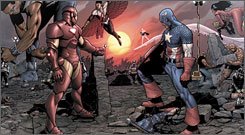
I've been reading Mark Millar's much-hyped, much-discussed, much-delayed, much-criticized Civil War series and wanted to raise a few quick points. First, I like it. I don't love it - I recognize that it has problems - but I like it. I liked the Spider-Man revealing his identity bit, liked how it worked within the story, and I liked how they handled the build-up to it in Amazing. What I haven't liked as much is the extremity of the rift between superheroes. I find myself wondering if they should have named it Civil Disagreement, because the War part is feeling forced. Even with all of the build-up, the "Road to Civil War" stuff, the Illuminati special, the tie-ins - even with all of that storytelling weight and verbiage this still feels rushed. or, more specifically, the ease and quickness with which the sides have resorted to such epic violence feels forced. But at the same time, these are superhero comics, and the notion that everything becomes very quickly about violence has certain fairness about it.
But the one thing that I've actually liked, that so many others have mocked, the thing that's spurred this post, is the depiction of the relationship between Iron Man and Captain America. I keep reading fans and critics mocking the notion that such long-time friends, long-time crime-fighting partners, would come to blows like this. And yet to me it feels pretty right. I've hardly read the entire runs of The Avengers, Iron Man, or Captain America, and yet I always had the feeling that - while they were friends, and did respect each other - Iron Man and Captain America have always had opposing views. And we've seen those differences come to a head before.
In the "Armor Wars" saga that ran in Iron Man many years back, the two Avengers fought when Iron Man, in an effort to destroy purloined armor tech from a host of bad guys, also went after the Vault-guarding Guardians, with Captain America, in his then-current guise of The Captain, fighting against him. And in the Avengers saga "Galactic Storm" some years later, we again saw a rift formed in the Avengers rank over the question of what to do with the genocidal Kree Supreme Intelligence - kill him or not, with Iron Man and Cap leading the opposing factions. So this notion of Iron Man and Captain America coming to blows over different philosophies is not new - it's an organic development in a long-evolving relationship. And some of the recently released fourth issue's flaws (a clone of Thor? Really?) aside, it's to see that evolution continue and (for the time) resolve somehow that has me looking forward to issue five.
Until Whenever
Friday, September 22, 2006
Jericho
And I had such high hopes for this show. The premise is good, and some of the stuff in the pilot was effective (little boy looking at mushroom cloud, answering machine-captured death), but that - IN THE PILOT - they resorted to such an old TV cliche as the "emergency tracheotomy" was very disappointing. On top of that half of the action and suspense in the pilot - THE PILOT - had nothing to do with the possible end of the world, but instead was the result of random car crashes. What!? You get one hour to hook us on this concept and you waste much of it on contrived standard-issue TV tropes? Why?
My Name Is Earl
Nice that they are abandoning the every-episode-must-see-an-item-get-srcatched-off-the-list bit. And if Joy is in prison next week, then it might mean they'll be going after some longer arcs too. Very welcome. I laughed a LOT at this episode, so I'm glad to see that some of the structural repetition that made last season sometimes-wearying is being jettisoned.
The Office
A bit of a cop-out I thought on the whole Jim-Pam thing, but I have to admit to being hooked on what will happen next. And opening up the action to a second Dundler-Mifflin office is inspired, and will take some of the weight off the core cast. The gay stuff was as uncomfortably hilarious as anything the show has done so far - I was watching through my fingers.
ER
OK, Jaquandor, I'll give you this. A bit too much Job-like travails for our friends. Sam, who has had much drama and tragedy in her life already is kidnapped and raped in front of her sleeping kid? And then she kills her husband in cold-blooded murder? And Neela goes right from her husband's funeral to a shot-up ER and one friend almost dying and another almost dying AND getting an emergency hysterectomy AND giving birth very prematurely? And Luka, he of the my-kids-were-murdered-in-a-war-torn-country backstory, has all of that happen to his child and girlfriend/fiance/whatever? And alcoholic, crazy-Mom-having, crazy-brother-having, husband-abandoned Abby has all of that happen to her? Damn, this is depressing stuff. Still, it's wonderfully done depressing stuff, and the ending with Sam was unexpected and wonderfully played. I ain't going anywhere soon.
Until Whenever
1. "Pilate's Dream" - Andrew Lloyd Weber and Tim Rice - Jesus Christ Superstar (Original Concept Album)
Lovely little acoustic guitar-backed song in which Pilate dreams about Jesus' crucifixion and subsequent rise to figure of worship.
2. "Escape to Paradise" - Harry Gregson-Williams and John Powell - Chicken Run (Film Score)
Rousing, somehow very British, cut from the film.
3. "Your Fault: Last Midnight" - Stephen Sondheim - Into the Woods (Original Broadway Cast)
Great late-show patter number in which all of the surviving characters turn on each other before the Witch silences them all with a wonderfully sinister solo.
4. "Blue Chair" - Elvis Costello - Blood & Chocolate
Kind-of-standard forthright pop-rock from Costello.
5. "A Little Less Conversation" - Elvis Presley - Elvis 30 #1 Hits
Can't hear this song without picturing Robert and Amy's wedding dance from Everybody Loves Raymond.
6. "Now" - Stephen Sondheim - Putting It Together (1993 New York Cast Recording)
The synthesizers and revised-for-the-revue lyrics really kill the mood on this song, a pity in that the original featured one of the all-time greatest lyrics ever, with a lawyer pondering, in strict logical fashion, how to get his young, virgin bride to sleep with him.
7. "Finale" - Jonathan Larson - Rent (Original Broadway Cast)
The emotional - if a bit ant-climactic and cheating - ending to Rent.
8. "When in Love" - Alan Menken and Tim Rice - King David (World Premiere Recording)
The kind of slow, emotional, big-melody ballad Menken could write in his sleep.
9. "Daphne Descends" - Smashing Pumpkins - Adore
This song, off of the forgotten, but pretty good, Adore, has a very effective driving, melancholy beat.
10. "Fallen" - K.D. Lang - Hymns of the 49th Parallel
Torchy, gorgeous, and sad - a great ballad and performance.
Until Whenever